 By Trenton Sam
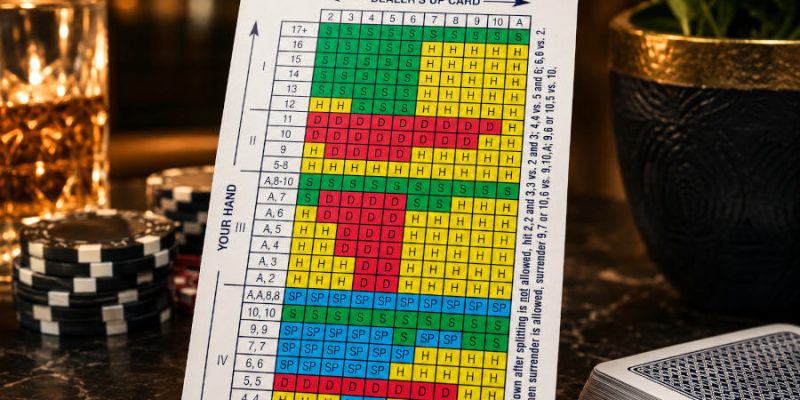
Blackjack stands alone on the casino floor as the single game where player choices directly influence the mathematical house edge. While slot machines and roulette wheels rely entirely on unchangeable probabilities, blackjack rewards disciplined decision-making and deep mathematical understanding. Playing on pure intuition or gut feeling guarantees long-term losses because the casino advantage grows significantly with every incorrect move. To tilt the mathematical balance as close to even as possible, players must master basic strategy, a system derived from computer simulations and probability theory that dictates the mathematically optimal play for every single hand combination.
Understanding the Foundation of Basic Strategy
Basic strategy is not a mystical secret or a system of superstition. It is a mathematically proven set of rules calculated by analyzing every possible combination of player cards against the dealer face-up card. Computers ran millions of hands to determine whether hitting, standing, doubling down, or splitting yields the highest expected return over time.
-
Minimizing the House Edge: Using basic strategy reduces the casino advantage to less than one percent on standard tables.
-
Removing Emotion: Relying on a fixed matrix eliminates fear and greed, preventing reckless moves after a string of losses.
-
The Dealer Upcard Priority: Every decision begins by looking at what the dealer shows, because that single card dictates the likelihood of the dealer busting.
Hard Totals and How to Play Them
A hard total is any hand that either does not contain an ace or contains an ace valued strictly as one because counting it as eleven would cause the total to exceed twenty-one. Hard totals present the most straightforward yet critical decisions on the felt. When holding a rigid number, players must balance their desire for another card against the absolute danger of busting.
-
Hands of 8 or Less: Always hit, as it is mathematically impossible to bust on a single card draw.
-
The Danger Zone of 12 through 16: These hands require extreme care. When the dealer shows a weak card from four through six, standing on a twelve through sixteen becomes optimal because the dealer is statistically likely to bust. Conversely, if the dealer shows a seven or higher, hitting is mandatory because the dealer likely holds a strong hand.
-
Hard 17 and Above: Always stand. The risk of busting far outweighs any potential benefit of drawing a low card.
Soft Totals and Maximizing Value
Soft totals include an ace that can be counted as either one or eleven. Because the ace provides a flexible safety net that prevents an instant bust on a hit, soft hands allow players to play aggressively, especially when doubling down. Many amateur players misplay soft hands by standing too early, missing crucial opportunities to extract maximum value from the dealer.
-
Soft 13 and Soft 14: Always hit, and double down against a dealer five or six if the rules permit.
-
Soft 15 and Soft 16: Hit by default, but look to double down when the dealer shows a four, five, or six.
-
Soft 17 and Soft 18: Stand against a weak dealer card like a two, seven, or eight, but double down against a three, four, five, or six to build a larger pot when the dealer is vulnerable.
-
Soft 19 and Above: Always stand. These hands represent exceptionally strong positions that rarely require further risk.
The Science of Splitting Pairs
Being dealt a pair offers one of the most exciting moments in a blackjack session, but it also demands strict mathematical discipline. Splitting transforms a single mediocre hand into two separate betting opportunities, but making the wrong split can devastate a bankroll.
-
Aces and Eights: Always split pairs of aces and eights. Splitting aces gives the player two separate chances to start with a strong eleven, while splitting eights rescues a terrible hard sixteen and turns it into two potential hands starting with eight.
-
Fives and Tens: Never split tens, as a hard twenty is an elite winning hand that should never be broken. Never split fives either, because two separate fives are better played as a hard ten with a strong opportunity to double down.
-
Fours, Sixes, Sevens, and Nines: The correct play for these pairs depends entirely on the dealer upcard. For instance, split sevens against a dealer seven or lower, but hit if the dealer shows an eight or higher.
Doubling Down for Maximum Leverage
Doubling down is the primary tool used to increase profits when the mathematical advantage shifts to the player. It allows a player to double their original wager in exchange for receiving exactly one additional card. Knowing when to deploy this weapon separates casual gamblers from sharp strategists.
-
Hard 10 and 11: Always double down on a hard ten unless the dealer shows a ten or an ace. Always double down on a hard eleven against any dealer card lower than an ace to capitalize on the high probability of drawing a ten-value card.
-
Soft Hand Doubling: As noted earlier, soft hands against low dealer cards provide prime double-down territory because the safety net of the ace eliminates the fear of busting on the single draw.
Common Strategy Mistakes to Avoid
Even players who attempt to use basic strategy often fall victim to common psychological traps that eat away at their bankroll. Recognizing these errors helps preserve the low house edge guaranteed by the matrix.
-
The Never Bust Myth: Many players refuse to hit a hard twelve or thirteen against a dealer ten because they are afraid of busting. Statistically, the dealer makes a hand far more often than not when showing a ten, meaning standing on a twelve is a losing play over time.
-
Copying the Dealer: Players often mimic the dealer by refusing to hit anything over twelve and always hitting seventeen. This is a fatal mathematical error because the dealer plays second and does not face the same bust dynamics as the player.
-
Buying Insurance: Insurance is a side bet offered when the dealer shows an ace. Mathematically, insurance is a sucker bet with a high house edge that should always be declined in basic strategy play.
Frequently Asked Questions
What is the exact house edge when using basic strategy?
When a player follows basic strategy perfectly on a standard game with favorable rules, the house edge drops to approximately 0.5 percent, making it one of the best bets in the casino.
Does basic strategy guarantee winning every session?
No strategy can guarantee a winning session in the short term due to the natural variance and luck involved in card dealing. Basic strategy minimizes losses and maximizes winning chances over the long run.
Why are surrender options important in blackjack?
Surrender allows a player to forfeit half their bet and fold a terrible hand like a hard sixteen against a dealer ten when the mathematical odds of winning are extremely low.
Can card counting be combined with basic strategy?
Yes, card counting builds directly on top of basic strategy, allowing players to deviate from standard chart plays when the remaining deck composition changes significantly.
Are table rules more important than strategy?
Table rules heavily impact the house edge. Rules that pay 3 to 2 for blackjack rather than 6 to 5, and games that allow doubling after splits, are critical for maximizing the effectiveness of basic strategy.
Why should players never place the insurance bet?
Insurance pays 2 to 1, but the true mathematical odds of the dealer holding a ten-value card underneath an ace are worse than that, resulting in a high house advantage for the casino.
How many decks are typically used in a basic strategy game?
Basic strategy charts apply to single-deck, double-deck, and six-to-eight-deck shoe games, though minor rule adjustments exist depending on whether the dealer hits or stands on a soft seventeen.